
Can Cindy Rose rebuild WPP?
28 May 2026Good quality measurement is critical in marketing. Marketers are investing shareholder funds. Shareholders are looking for returns, and returns can only be maximised if marketing investments are properly measured, understood and optimised. But unfortunately, most current marketing and media measurement is inaccurate. The chief culprit in this inaccuracy is Last Touch Attribution (LT).
LT has been called a “dangerous fiction” [1] that “gives 100% of the credit for a conversion to the last touch point before the user made a purchase or completed a desired action (the touchpoint usually being an impression or an ad click). It does not matter what other ads were seen before that one, how the customer moved through the funnel, or which channels were most effective at influencing their journey. If your impression or click wasn’t last, it didn’t count.” [2].
What really happens before the last click?
Think of any purchase you made online that involved a google search before you visited the website you purchased from.
Let’s consider as an example, how a car hire purchase might work. Your Google search will have been triggered by a need; you needed a hire car, this may be because it’s now school holidays, you are taking a summer vacation. The weather for the next two weeks is good so you decide to do some travelling around. You may “trust” some brands you know like Hertz, Avis or Sixt. You see Avis is running a promo which makes it more competitive on the same car group you want to hire. Then you go to Google and click to visit a web site or a car hire aggregator.
Now let’s break this down. To make your decision you were informed by these journey points:
- It is school holiday time – this is a repeating seasonal pattern; school holidays occur at roughly the same time every year
- You are taking a vacation – a sub-pattern within the repeating seasonal summer holiday pattern
- The weather is going to be good – weather is affecting your decision
- You prefer brands you trust – this is important because without this brand trust you might not purchase from one of these companies
- You see the price promo from Avis – price promos can successfully pull buyers from one offer to another
- Only then do you click on Google and your behaviour becomes a last touch attribution metric.
More and more marketers are recognising that Last Touch attribution does not provide measurement of the full journey:
- Disney’s Dana McGraw thinks advertisers should “look at the whole picture to understand performance, rather than rely on the expedience of last-touch attribution” [3].
- Even Google have recognised that last touch is not the complete picture when they said “Everyone has been overlooking the mid-funnel. Even us [4].
- Neil Patel, one of the most respected independent voices in search marketing, has said that “Last-click attribution is lying to you” [5].
- The American Marketing Association states that: “Single-touch models, such as last-touch attribution and first-touch attribution, do not account for all events leading to conversion” [6].
How misleading can last touch measurement be?
The short answer is very misleading. Even dangerously misleading. Let’s illustrate how wrong Last Touch reporting can be.
In the chart below we see a comparison of the contributions to campaign performance across a number of drivers and between Last Touch reporting and Full Funnel MMM reporting. These include media channels, plus non-media drivers like price promotions, seasonality and brand trust scores.
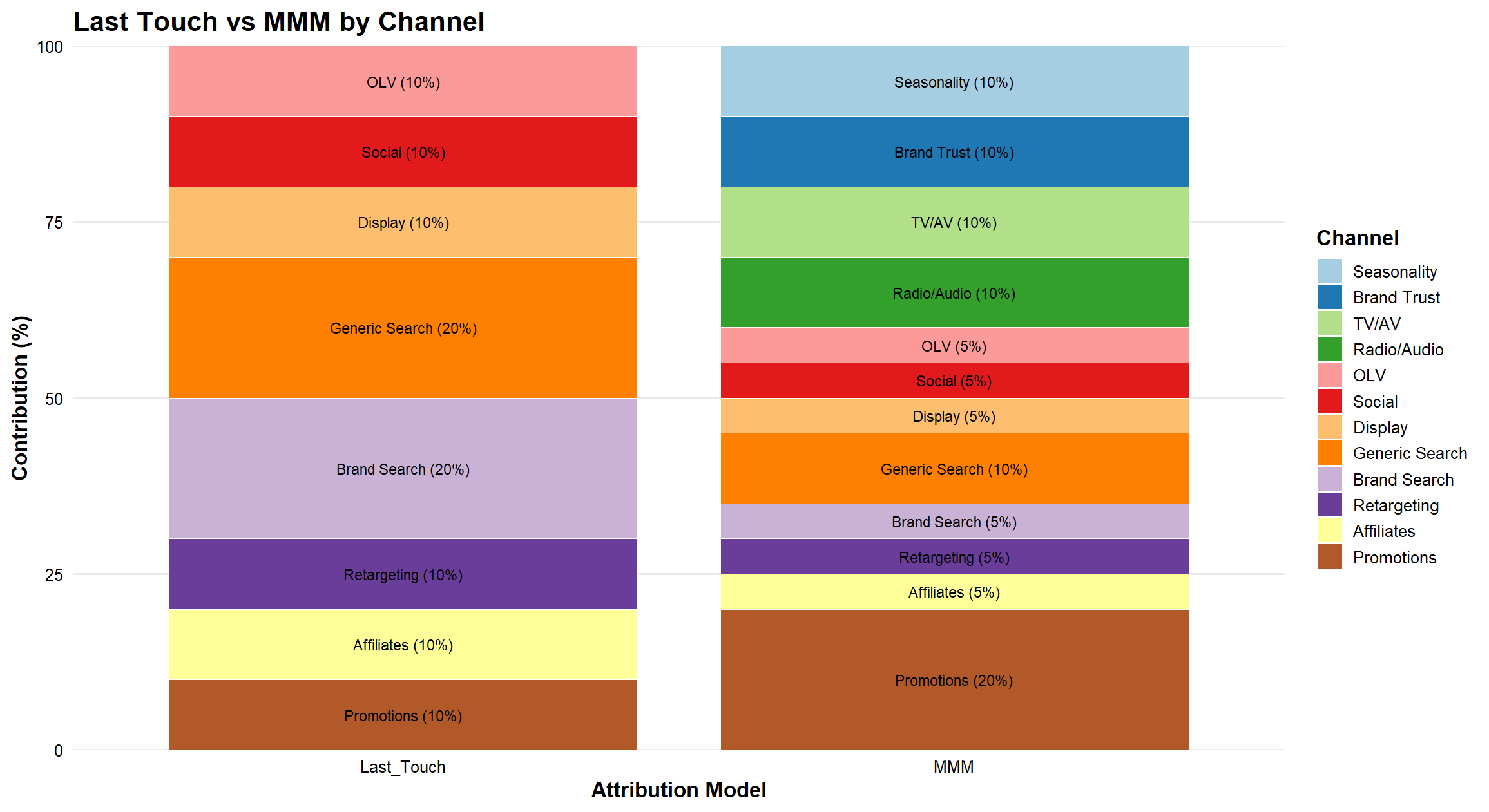
There are some notable differences here:
In Last Touch reporting, all the drivers are media drivers, apart from Promotions (10%) so 90% of sales are driven by media. But what’s also notable is the fact that all the channels reported are digital channels. This is because these channels are reportable through digital tracking devices.
In Full Funnel MMM reporting, we see the introduction of important non-media drivers that explain a significant share of the sales – Promos are found to drive 20% of sales, Brand Trust drives 10% and Seasonality drives a further 10%. These drivers are not measured by last touch.
We can see that Last Touch reporting is creating an illusion of media performance by misattributing non-media effects like price promos and seasonal demand shifts to media.
In the case above we see that:
- LT reports only digital channels
- MMM reports all drivers, including powerful non-media effects
- Last Touch reporting is overstating the effect of media to the tune of 40% of sales
If your reporting is telling you your digital media channels are delivering 1000 sales, they are actually delivering far less, probably about 60% of the total you see. And of course, if you base your media investment decisions on Last Touch metrics, you are therefore using substandard measurement findings and so you will be making substandard investment decisions.
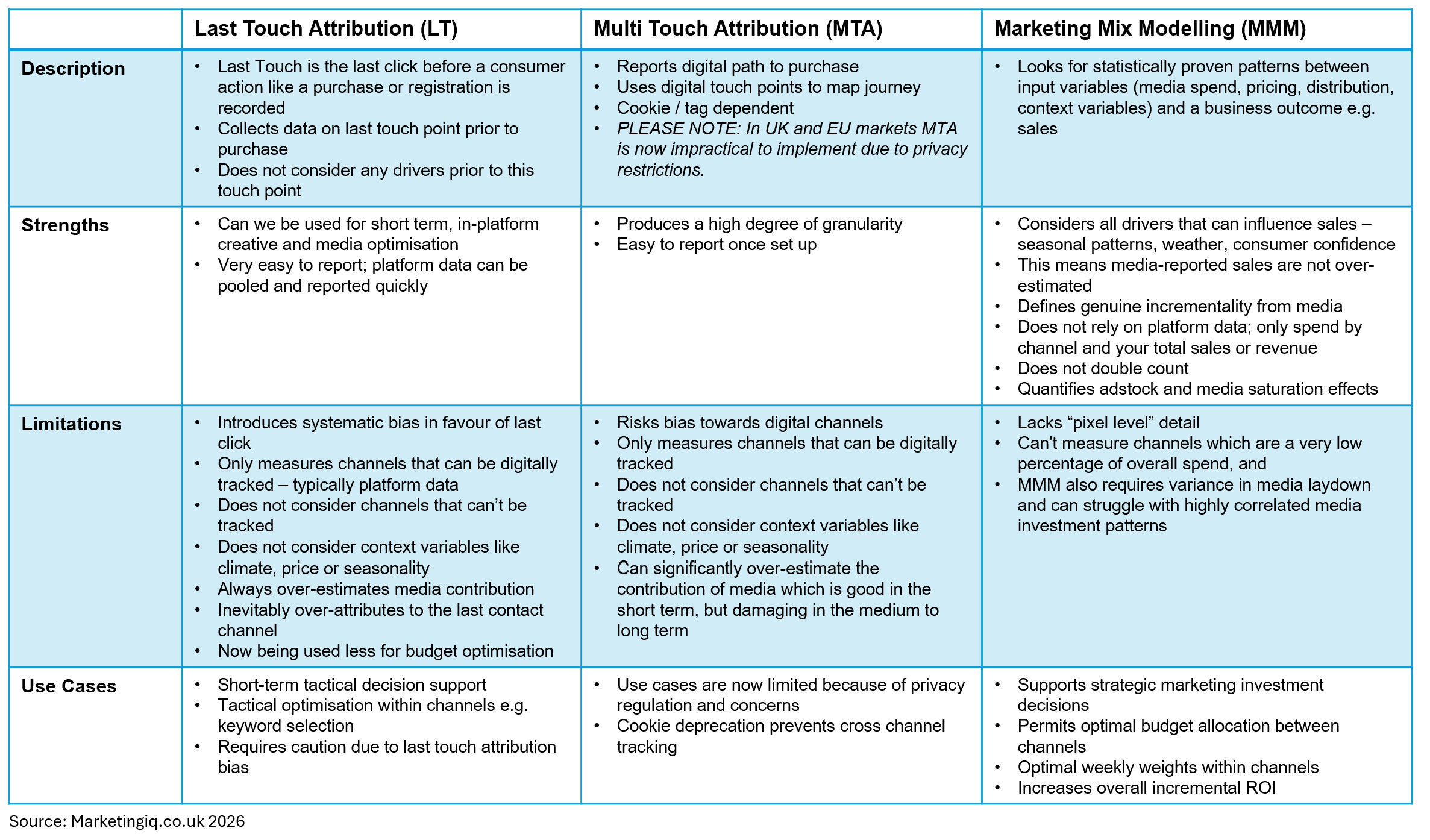
Let’s compare Last Touch and MMM in detail
This table covers and summarises the main points made so far. Please note that MTA is being largely deprecated across the UK and Europe as a result of privacy regulations.
Why is Last Touch platform reporting still being used?
Major digital platforms can create an illusion of accurate measurement; they offer daily, hourly and even minute by minute reporting of multiple metrics, campaigns, ad groups, ads, keywords, referring websites, countries, cities, and so on. These seemingly rich dashboards create an illusion of accuracy and certainty. When asked “how many sales did X generate last week“, the answer can be provided. So these platforms are convenient and expedient.
But despite their apparent data-driven accuracy and their high ease of use, these platforms are conspicuous for the information they do not contain. Going back to our car hire example, they do not suggest 40% of sales were not driven by media. They do not measure the impact of seasonality, price promos or brand attitudes. In short, Last Touch platform reporting does not provide what Disney’s Dana McGraw called the “whole picture“.
Implications for media planning and business growth
All businesses need to grow. But to grow you need to find the channels that bring new audiences, new buyers and new sales revenue to your company, brand and products. Last Touch reporting does not help to identify and isolate incremental growth.
- At the recent Business of Apps London (2026), Aidan Rouse, Head of Growth Advertisers for UK & Nordics at Snapchat, made the case that most growth teams are optimizing for where credit lands, not where growth actually comes from [7]. This is critical distinction.
- Byron Sharp of the Ehrenberg Bass Institute at the University of Adelaide studied the buyer behaviour and growth economics of many categories and brands [8]. Sharp found that incremental business growth is delivered by finding new audiences of new buyers. By definition this means you need reach.
Last Touch reporting will be giving you a false sense of security about your digital channels performance, you may find that your reporting metrics look great, but it will be diverting you from the main task; finding new audiences and new buyers.
If you want incremental business growth you must reduce your reliance on Last Touch reporting.
Can you measure media and non-media effects on sales simultaneously?
Yes, this can be done and Marketing and Media Mix Modelling or MMM is the best way to measure media and non-media effects simultaneously.
MMM is different because it doesn’t rely on digital tracking mechanisms and so that permits the measurement of many non-digital drivers. Instead MMM looks at patterns in changes in business outcomes vs changes in media and non-media inputs. For each input variable MMM estimates the degree of change in the output variable, e.g. sales for every 1 unit change in the each of the input variables; that could be for every £1 change in social media spend, every £1 change in OLV spend or every £1 change in TV/AV spend. Plus MMM can estimate the sales change for every 1 degree Celsius change in temperature, or every 1mm of additional rainfall or every £1 price discount vs the list price if a sales promotion is running. With this unit coefficients in place, a Marketing Mix Model can show you the pattern of how each of the drivers contributes to the creation of sales, especially sales that are incremental to underlying seasonal patterns.
Summary and actionable insights
Last Touch reporting is a broken measurement system. It does not provide the full picture of what drives sales. Digital channel performance will be being overstated. I don’t mean might be being overstated, I mean it will be being overstated. Relying on last touch attribution might be the path of least resistance, but in today’s world, it is also the path of least return on investment [9].
If you are relying on last touch attribution you are optimising your brand and products into decline and out of successful growth.
Marketing and Media Mix modelling offer a compelling solution to the problem of measuring media and non media drivers together. MMM measures non-media drivers like seasonality, weather and economic context. MMM measures the effect of non-digital media channels, the so called audience builders: TV/AV, OOH, Cinema and Radio. And of course it measures digital media channels- set in the correct context.
Find out more about our full funnel MMM services here:
Quick References
- Why Last Touch is a Trojan Horse for Walled Gardens, Mattia Fosci, Advertising Week, https://advertisingweek.com/why-last-touch-attribution-is-a-trojan-horse-for-the-walled-gardens/
- Mattia Fosci, Advertising Week, as above
- Disney’s Dana McGraw says last touch attribution missed the full picture, The Current: https://www.thecurrent.com/video/disney-dana-mcgraw-last-touch-attribution-misses-full-picture
- Think with Google: https://business.google.com/en-all/think/consumer-insights/mid-funnel-marketing-brand-performance/
- Your best ads are failing because you’re measuring them wrong, Neil Patel: https://www.linkedin.com/posts/neilkpatel_paidads-datatruth-marketingmetrics-activity-7398344791094116353-_6zj
- Multitouch Attribution in the Customer Purchase Journey, Kannan, P.K., and Hongshuang (Alice) Li (2021), Impact at JMR, (April), Available at: https://www.ama.org/multitouch-attribution-in-the-customer-purchase-journey/
- Why last-touch attribution is costing you growth – Event spotlight – Business of Apps London Where apps grow June 26, 2026 https://www.businessofapps.com/insights/why-last-touch-attribution-is-costing-you-growth/
- How Brands Grow, Byron Sharp, Oxford University Press, 2010.
- Why Marketers Need To Stop Focusing On Last-Touch Attribution, Jeremy Fain, Former Forbes Councils Member, Forbes June 28, 2018
